What each loader does with obSCEne
Results, per loader, from the reports themselves.
docs/EMULATORS.md says what each loader is and how
to run it; this says what happened.
The table is generated by
obscene-tool compat, and verify.sh fails if it
has drifted from the reports it was built from. A hand-written results
table would be stale within a day - this project has measured what that
costs (D069).
Results
| host | shadPS4 | PS5PCEM | fpPS4 | kyty | orbistoun | |
|---|---|---|---|---|---|---|
| Records | 36559 | 36575 | 36432 | 194 | 36520 | 36549 |
| Ran to the end | yes | yes | yes | no | yes | yes |
| Output channel | host | sceKernelWrite | write | - | puts | sceKernelWrite |
| Pass / partial / fail / skip | 116/15/358/26 | 456/7/37/15 | 118/68/262/67 | - | 429/11/45/30 | 416/16/56/27 |
| Excluded to keep the loader alive | 0 | 0 | 0 | 0 | 0 | 0 |
| Skipped after dying on a previous run | 0 | 4 | 0 | 19 | 11 | 3 |
| Capabilities established | 7 | 9 | 8 | - | 7 | 6 |
| Checks blocked behind a missing one | 3 | 3 | 0 | - | 12 | 3 |
| Deepest wholly-green section | 20 | 25 | 20 | - | 25 | 4 |
| Census present / absent | 826 / 34505 | 35330 / 0 (void) | 3732 / 31598 | 0 / 0 | 35330 / 0 (void) | 35330 / 0 (void) |
| Probed functions responding / silent | 54 / 0 | 22 / 32 | 0 / 0 | 0 / 0 | 26 / 28 | 31 / 23 |
| Died in | 900-surface/control |
000-boot/number-formatting |
000-boot/number-formatting |
000-boot/number-formatting |
000-boot/number-formatting |
000-boot/number-formatting |
Sections the loaders do not agree on, pass/partial/fail/skip:
| Section | host | shadPS4 | PS5PCEM | fpPS4 | kyty | orbistoun |
|---|---|---|---|---|---|---|
000-boot |
4/0/0/0 | 4/0/0/0 | 4/0/0/0 | 4/0/0/0 | 3/0/1/0 | 2/2/0/0 |
005-generation |
0/1/0/1 | 1/1/0/0 | 1/1/0/0 | 1/1/0/0 | 1/1/0/0 | 1/1/0/0 |
007-responsive |
2/0/0/0 | 0/2/0/0 | 0/0/0/2 | 0/0/0/2 | 0/1/1/0 | 0/2/0/0 |
010-kernel |
3/0/0/0 | 3/0/0/0 | 3/0/0/0 | 2/1/0/0 | 3/0/0/0 | 3/0/0/0 |
015-sync |
11/1/0/2 | 12/1/1/0 | 11/0/1/2 | 12/0/1/1 | 7/2/4/1 | 5/0/7/2 |
017-posix |
4/0/0/1 | 1/0/4/0 | 0/0/0/5 | 0/0/0/5 | 2/0/3/0 | 0/0/4/1 |
018-relational |
18/0/0/0 | 18/0/0/0 | 17/0/1/0 | 16/0/1/1 | 14/0/1/3 | 8/0/2/8 |
020-memory |
4/0/1/4 | 9/0/0/0 | 8/0/0/1 | 9/0/0/0 | 8/0/0/1 | 2/0/3/4 |
030-thread |
3/0/0/0 | 3/0/0/0 | 3/0/0/0 | 3/0/0/0 | 3/0/0/0 | 2/1/0/0 |
035-libc |
30/0/0/0 | 5/1/19/5 | 0/0/0/30 | - | 0/1/15/14 | 10/1/16/3 |
037-math |
13/0/0/0 | 3/0/10/0 | 0/0/0/13 | - | 0/0/13/0 | 0/0/13/0 |
040-file |
5/0/0/2 | 5/0/1/1 | 6/0/1/0 | - | 6/0/1/0 | 2/2/3/0 |
050-time |
1/0/0/0 | 1/0/0/0 | 1/0/0/0 | - | 1/0/0/0 | 0/0/1/0 |
060-module |
3/0/0/0 | 3/0/0/0 | 3/0/0/0 | - | 1/0/1/1 | 2/0/1/0 |
070-user |
0/0/2/0 | 2/0/0/0 | 2/0/0/0 | - | 2/0/0/0 | 0/0/2/0 |
080-video |
1/0/0/2 | 0/0/0/3 | 1/0/0/2 | - | 0/1/0/2 | 2/0/0/1 |
090-audio |
1/1/0/0 | 2/0/0/0 | 2/0/0/0 | - | 2/0/0/0 | 1/1/0/0 |
100-input |
1/1/0/1 | 3/0/0/0 | 3/0/0/0 | - | 2/1/0/0 | 1/1/0/1 |
110-modules |
1/0/0/3 | 2/0/1/1 | 1/0/0/3 | - | 0/0/1/3 | 1/1/1/1 |
120-measure |
4/0/0/0 | 3/1/0/0 | 4/0/0/0 | - | 3/1/0/0 | 1/1/2/0 |
130-layout |
3/0/0/1 | 3/0/0/1 | 0/2/0/2 | - | 0/2/1/1 | 2/1/0/1 |
150-memory-map |
1/1/0/0 | 2/0/0/0 | 0/0/2/0 | - | 0/0/2/0 | 1/0/0/1 |
165-gnm |
0/0/0/2 | 2/0/0/0 | 0/0/0/2 | - | 2/0/0/0 | 1/1/0/0 |
900-surface |
2/10/355/3 | 368/1/1/0 | 47/65/257/1 | - | 368/1/1/0 | 368/1/1/0 |
Real hardware is the source of truth, not a column here
There is deliberately no hardware column in the table above. A retail PS5 is not a loader being compared - it is the thing every loader in that table is scaffolding toward, and obSCEne has run on one. Its results have their own document, cited record by record:
→ docs/HARDWARE.md -
what a real PS5 answered. The full account: which libraries the
console maps and binds, which failures are the platform's and which are
the module's, the video-out alignment finding, the media-codec loads
that take the process down, and the two committed runs behind it -
data/hardware/ps5-full.txt (before imports bound) and
data/hardware/ps5-imports.txt (after).
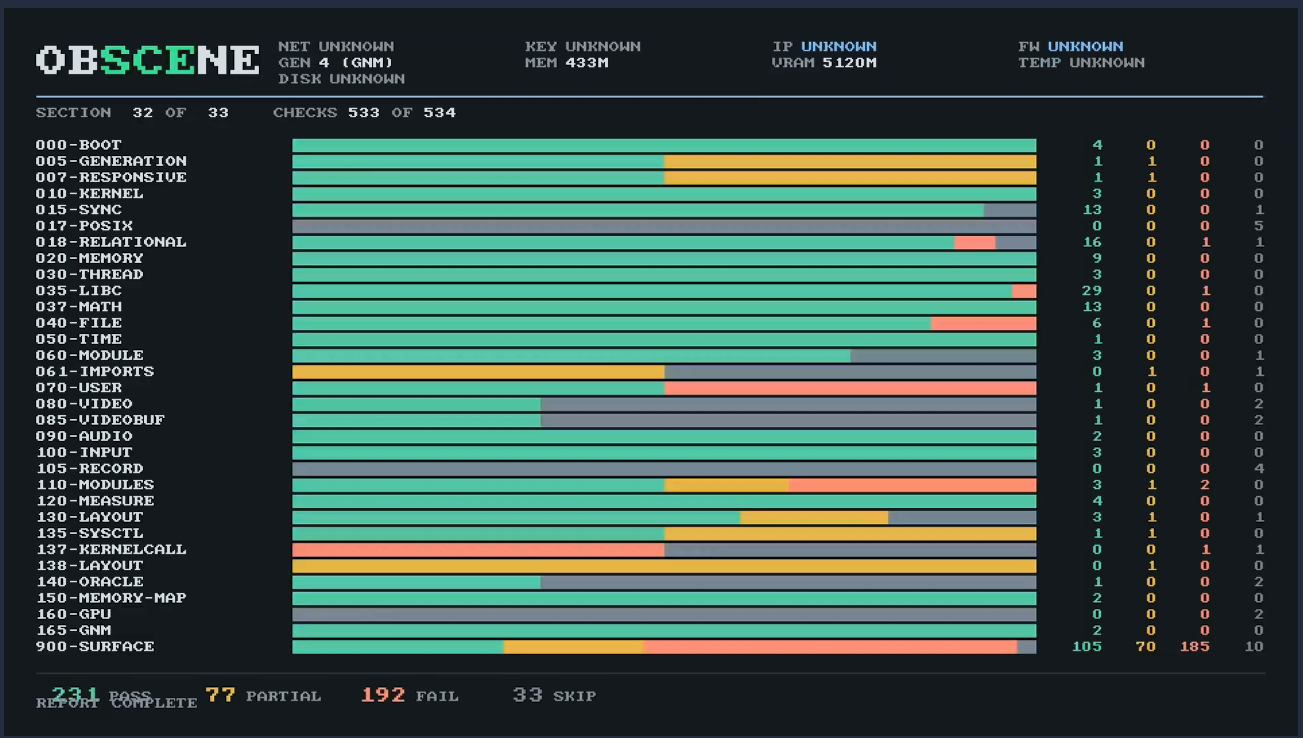
The suite runs to completion on the console and draws its own report
to the screen. Most of the red is one thing - libraries the console will
not load for a title of this category - which is a finding about the
platform, not a defect in obSCEne; HARDWARE.md separates the two. The
numbers are not repeated here on purpose: this is a
measurement, and pasting it beside a table regenerated
from emulator reports and gated against drift (D069) is precisely the
hand-maintained staleness this document quarantines patched-loader
results for. ./bin/obscene report and
./bin/obscene deploy capture a fresh run off the console;
read the standing ones where they are cited.
What these results are for, and what they are not
These loaders are scaffolding, not the standard. They exist here to get obSCEne running before hardware is available, and to give the report something to be checked against while it has nothing else. The source of truth is real hardware; the direction of travel is that obSCEne and its sibling become the reference these loaders are measured against, not the other way round.
That matters for how a failure in this table should be read. A loader that cannot run obSCEne is not automatically evidence that obSCEne is malformed, and the current shadPS4 is the case that makes the distinction concrete.
Current shadPS4 refuses to load the corpus build, and that is a firmware gap
Built from its own source (be21649), shadPS4 stops in
the loader:
LoadModule: Provided file /app0/sce_module/libc.prx does not exist
preloadModulesForLibkernel: Assertion Failed!
libc.prx cannot be loaded, but the guest attempted to use it.
obSCEne declares the platform libraries it works with in
DT_NEEDED, which is what the tag is for and what a real
title does. On the hardware those modules exist -
libc, libSceFios2 and the rest ship with the
firmware, the loader loads them, and nothing here fires.
shadPS4 has no firmware to load, because this toolkit is deliberately
firmwareless. Faced with a declared dependency it cannot satisfy, it now
asserts. The binary this project measured with previously printed
Failed to preload libc, expect crashes and carried on -
same module, 65,665 log lines against 33,044, and a run that reached
040-file instead of dying at load.
So the change is in the emulator's tolerance, not in obSCEne's correctness. What obSCEne asks for is what the hardware provides; a loader without the hardware's libraries is entitled to say so, and choosing to make it fatal is its call rather than a defect being reported here. The module is unchanged and still loads on the older binary, on fpPS4, and on PS5PCEM.
One thing genuinely open on our side. The corpus
spans 23 firmware versions and no single hardware carries every library
in it, so a large set of hard dependencies is not obviously right for
hardware either - for a different reason than the one above. The durable
answer is probably not DT_NEEDED at all:
sceKernelLoadStartModule and sceKernelDlsym
would let the census ask the platform at runtime and read its error
code, which is stronger evidence than a resolved address on a loader
that stubs whatever it cannot find (D140). Tracked in D149.
How to read it, and how not to
This is not a ranking. A pass count is not a quality score:
- a loader that resolves every import to a generic stub scores well on presence and badly on behaviour - shadPS4 reports all 87 current-generation graphics symbols present for an interface it does not implement at all;
- a loader that resolves only what it implements scores nothing on presence while being the most honest of the group;
- and a loader that refuses to run scores nothing at all while telling you something true about your module.
A census marked (void) is not a small number
written oddly. 900-surface/control probes one
symbol that must resolve and one that cannot exist. A loader that
stub-resolves everything answers "present" to the impossible one, the
control fails, and in its own words every count in that section is
meaningless. shadPS4 and fpPS4 both fail it, so their
35,337-of-35,337 and 376-of-376 are not measurements of a platform -
they are measurements of a loader that says yes to anything. The numbers
are shown rather than hidden, and marked, because the comparison a
reader would otherwise make is against PS5PCEM's 3,736, which
was measured.
This is the table catching itself. The control's verdict was in every report all along and the table ignored it, presenting a void count beside a real one with nothing to separate them.
The number worth steering by is "checks blocked behind a missing one." It counts the suite sitting behind the floor, and unlike a pass count it cannot be moved by resolving more symbols. See D067.
Per-section tallies are kept rather than merged, because "fails everything in one section" and "fails one check in each of eight" are different platforms and a total hides which.
Presence versus behaviour, measured
Everything above argues that a pass count is not a quality score because a stub-everything loader scores well on presence. That was an argument. On 2026-08-24 it became a measurement.
910-bulk calls every censused symbol
with nothing in its arguments and records what came back. Against
shadPS4 it reached the end of the list - 32,466 entries, 26 rounds on
the final pass, resuming across four sessions:
| answered | 32,275 |
returned zero |
31,111 - 96.4% |
error-shaped |
961 |
rejected |
125 |
value |
78 |
| never returned | 191 |
The same loader's address census reports roughly 35,000 of 35,000 symbols present.
Why 96.4% zero is damning rather than ambiguous
Every call passes nothing - all arguments zero. A function taking an out-pointer cannot succeed on a null one; a function taking a handle cannot operate on handle zero. The correct answer for the overwhelming majority of these calls is a refusal, and refusing is precisely what a generic stub cannot do, because it does not know what it is standing in for.
So the zero rate is not "these calls happened to work". It is the shape of a loader that resolves an import to a function returning success and nothing else.
The useful half is the inverse
A high refusal rate means argument validation is running. These are the libraries where matching the loader's behaviour means matching something:
| library | refused / answered |
|---|---|
libScePlayGo |
13 / 13 |
libSceImeDialog |
13 / 13 |
libSceNpTus |
134 / 141 |
libSceRtc |
41 / 44 |
libSceNpAuth |
12 / 13 |
libSceNpSignaling |
22 / 24 |
libSceGnmDriver |
143 / 229 |
libkernel |
49 / 83 |
And the other end, which is the number worth quoting:
282 of 342 libraries answered only zero - every symbol,
24,532 of them, accepting anything and reporting success. Not
one call in any of those libraries was refused. libSceNet
answered 197 calls and objected to 18; the six
libSceAbstract* libraries answered 485 between them and
objected to none.
What it does not say
It is one loader. A different one would produce a different table and none of it is a hardware measurement - this behavioural map has never run on hardware, even though the suite itself has (see Real hardware is the source of truth above). The presence-versus-behaviour argument is confirmed on shadPS4 alone.
A zero is not proof of a stub. Some functions
genuinely succeed on zero arguments, and docs/OUTPUT.md is
explicit that this bucket cannot separate the two. The argument rests on
the proportion, not on any individual record.
It is not a defect report. A loader that stubs a library nobody has asked it to implement is doing the reasonable thing. The value here is a map of where an emulator has something to get wrong, which is a much smaller surface than the census implies - and the census is what a coverage number would be computed from.
Screenshots
obSCEne draws its report to the screen, which exists for the case where no text channel works. Most captures are the summary page, which answers "what happened" on its own.
All five loaders render the report. Kyty was the last holdout and needed a fix inside its own memory tracking rather than anything in this module - see the Kyty section below.
Capturing these needs more than a screen grab, and the reason is
worth knowing before trusting one. PrintWindow asks a
window to render itself, so it works when the window is behind something
or was never shown at all - and PW_RENDERFULLCONTENT is
required for anything drawing through a GPU compositor, which all of
these do. Without it the capture is a blank rectangle of the right size,
which is a convincing-looking wrong answer.
The window is also not always the one Windows will hand you.
MainWindowHandle reports the first top-level window created
by a process's main thread, and a loader that opens its window
from a render thread has a perfectly good window and a handle of zero.
Kyty's is also marked not-visible. screenshot.sh therefore
enumerates top-level windows by owning process id, prefers a visible
one, and falls back to any window larger than 64x64.
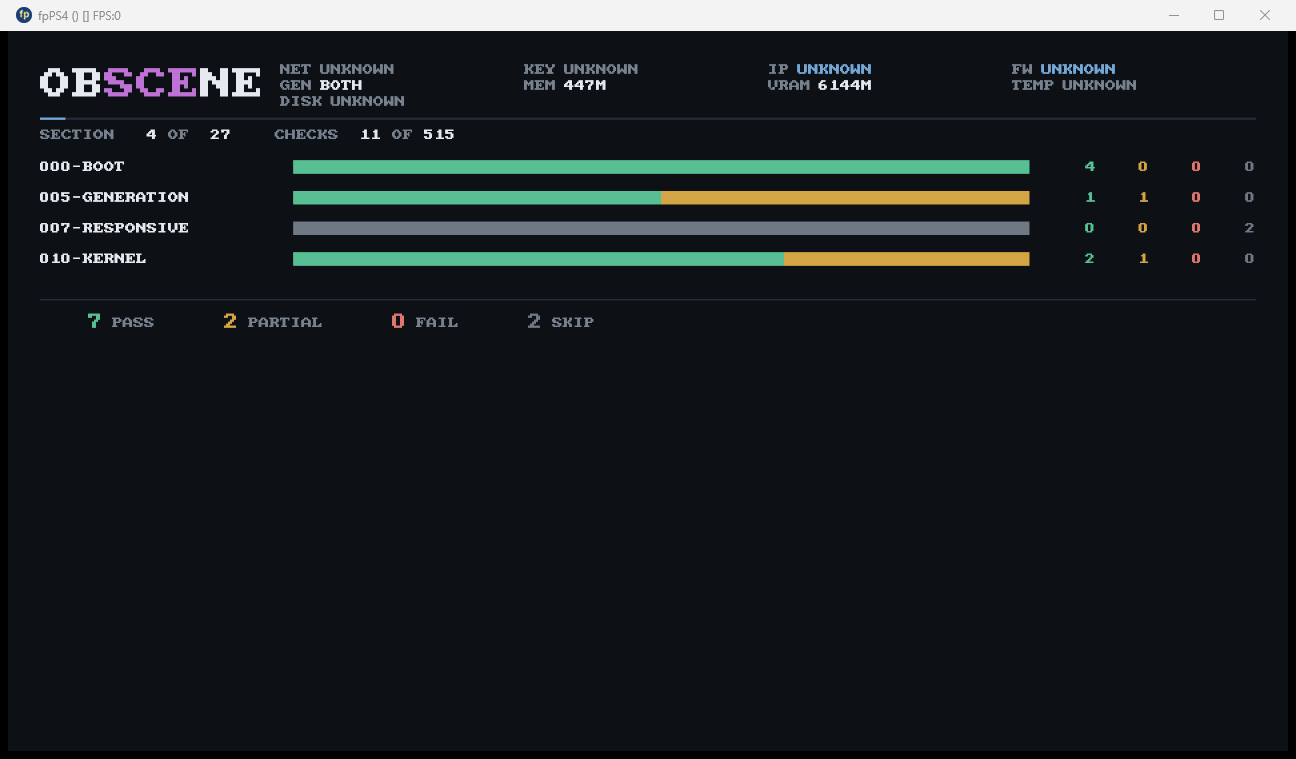
The fpPS4 one is a detail page instead, and was not chosen: once the
report is complete the presenter cycles, so what a capture lands on
depends on when the run finished. It is kept because it happens to show
the thing that section is about - individual 035-libc
checks passing and failing side by side - which the summary would have
reduced to one bar.
shadPS4 - previous generation
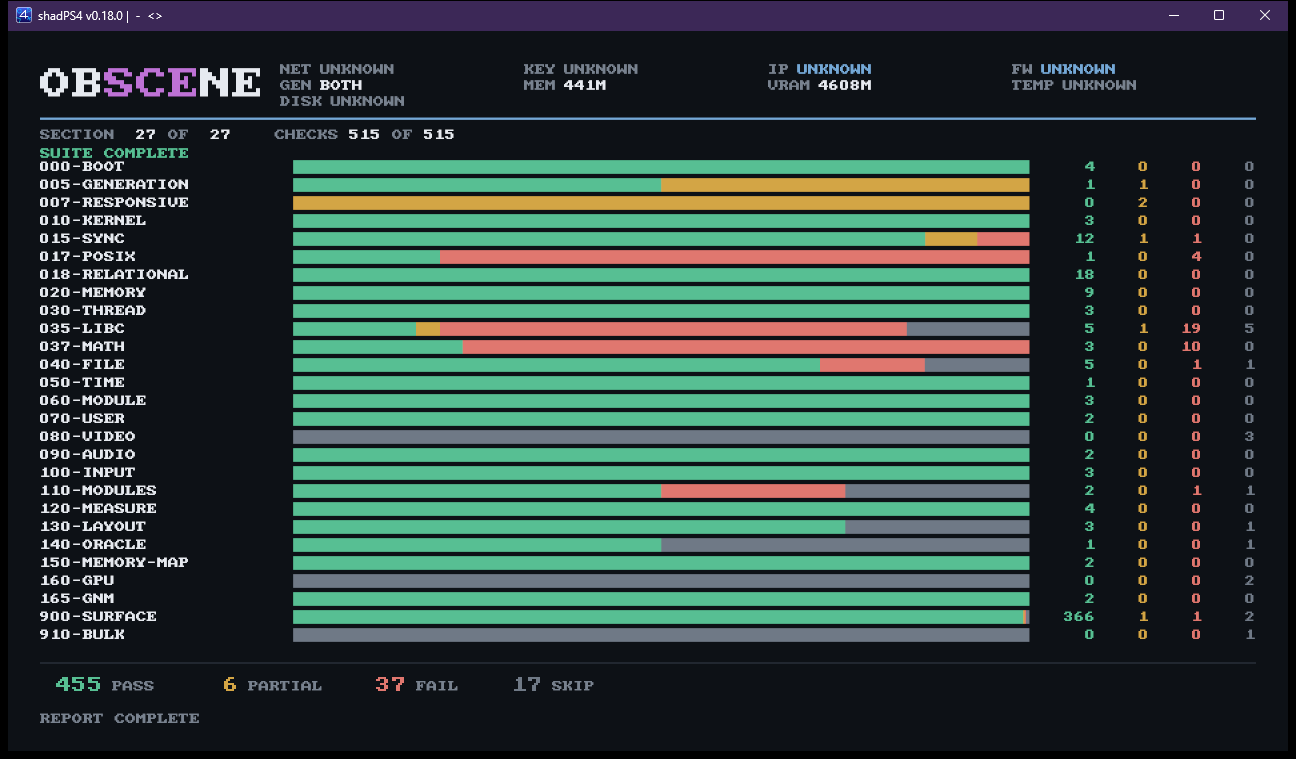
27 of 27 sections, 515 of 515 checks,
SUITE COMPLETE. 455 pass, 6 partial, 37 fail, 17
skip.
Note 900-SURFACE at 368 green: shadPS4 resolves nearly
every censused symbol, including libraries it does not implement. That
row is the stub behaviour of D130 rendered as a bar.
PS5PCEM - current generation
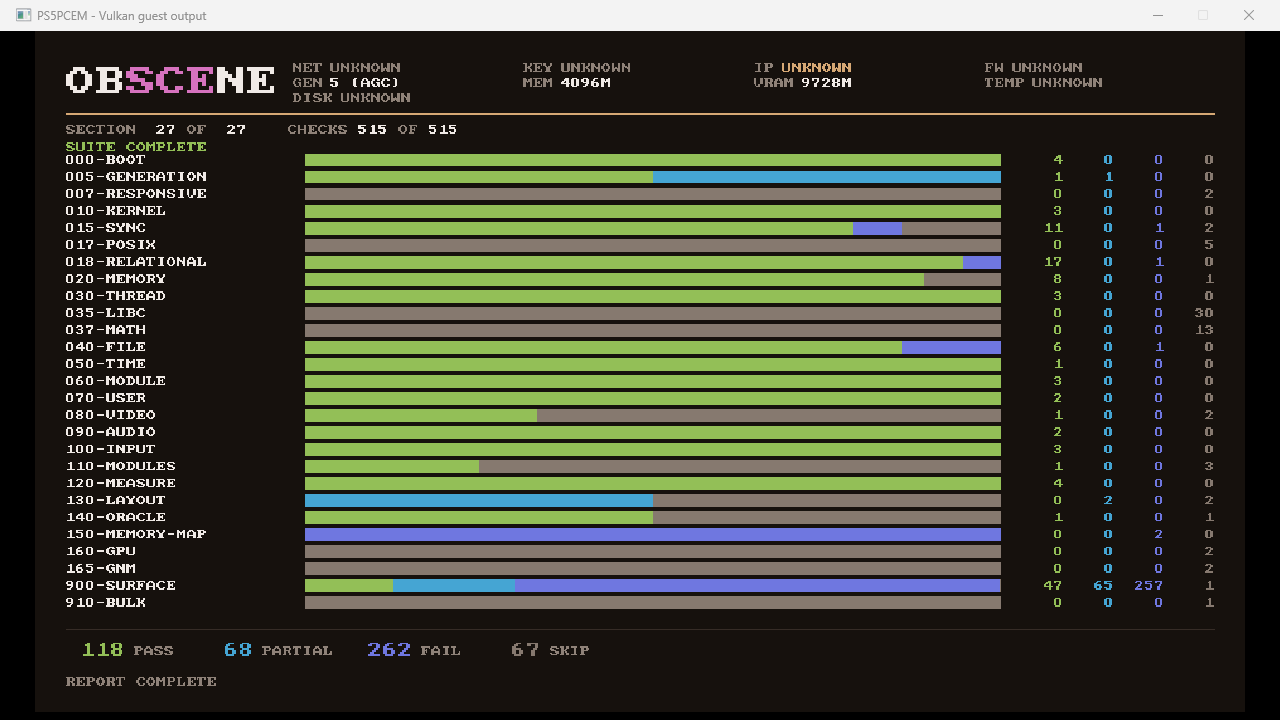
26 of 26 sections, 499 of 499 checks,
REPORT COMPLETE, and the header reads
GEN 5 (agc) - the first current-generation run this project
has produced.
The same source and the same binary logic as the shadPS4 capture above. The display works on both because it takes whichever video-out pair the platform actually has, preferring the older when both appear present (D111, D140).
900-SURFACE is the opposite shape here - mostly red,
because PS5PCEM resolves what it implements and nothing else.
fpPS4 - previous generation
26 of 26 sections, 148 of 148 checks,
REPORT COMPLETE - 81 pass, 7 partial, 5 fail, 55
skip. CORPUS=0, because each round of the sweep that got
here is a full run.
Reaching the end took 44 exclusions, found one at a
time over 35 sweep rounds. The first run stopped at 33 records, and the
walk that followed is the most detailed picture this project has of a
loader: 007-responsive/libc (strspn),
007-responsive/math, 015-sync/machine-kind,
five of 017-posix, twenty-two of 035-libc, all
thirteen of 037-math, and 010-kernel/is-stack.
Each was confirmed a hang rather than a slow check by re-running at
double the budget and getting the identical stopping point (D144).
The libc picture is mixed, and that is the interesting
part. Eight of the thirty 035-libc checks run to
completion - the screenshot above catches three of them:
malloc-free, calloc-zeroes and
realloc-preserves green, strncpy-padding and
strstr amber, the rest skipped. So allocation works and
most string handling does not return. 037-math has no
survivors at all: thirteen of thirteen hang.
That contrast is why the exclusion list names twenty-two
035-libc checks individually instead of the section (D145).
A section entry would have been right for 037-math and
would have reported eight working checks as fatal here.
The header now reads GEN UNKNOWN. It used to read
GEN 5 (CURRENT) for a module built GEN=4,
which was a finding rather than a bug - fpPS4 installs a logging stub
for every import it cannot resolve, so the current-generation graphics
symbols resolve too - and D140 is the correction: when both generations
appear present, presence proves nothing, and unknown is
what the header is entitled to say.
Kyty - silent, then fixed
This section describes a state Kyty is no longer in.
The generated table above has it running to the end and reporting
through puts; the fix was inside Kyty's own memory tracking
rather than anything here. What follows is kept because the diagnosis is
the useful part and it was right - two independent causes, both design
choices - and because a reader meeting the same silence elsewhere will
want it.
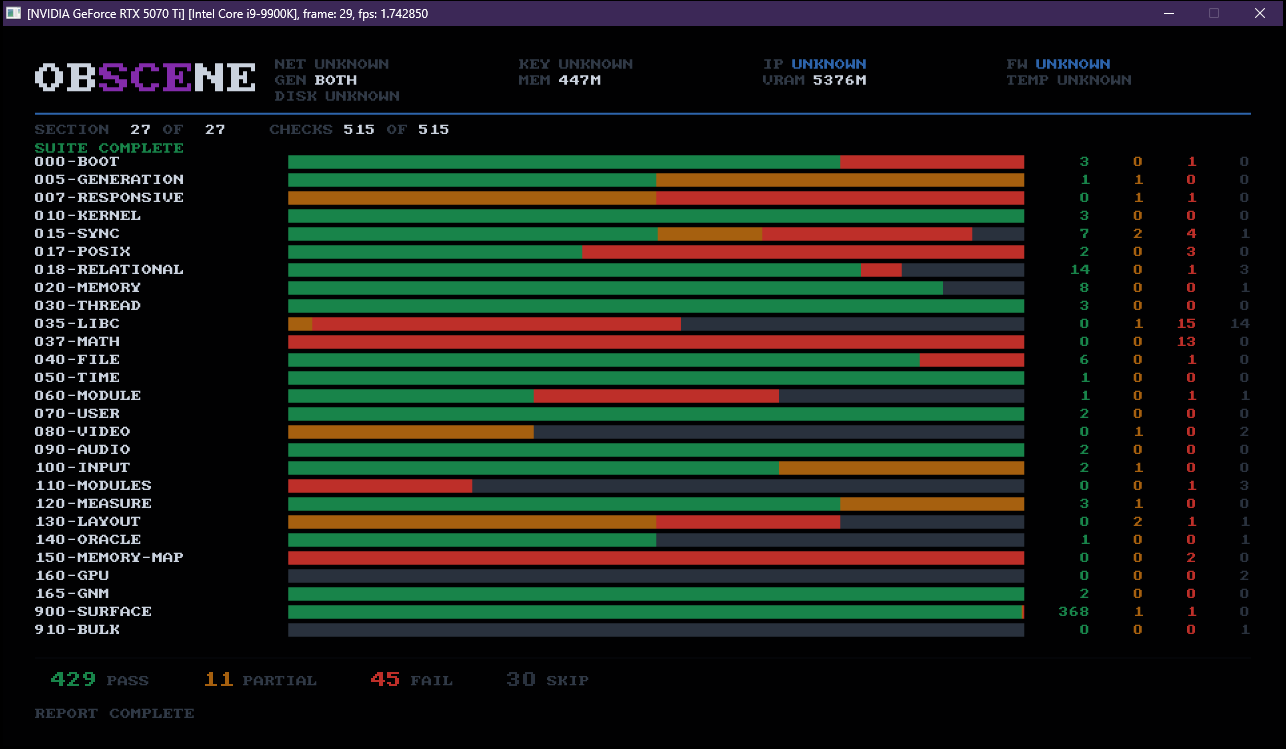
At the time: a black window whose title bar read
frame: 3062, fps: 59.98. Alive, presenting at full rate,
and the guest had drawn nothing into it. That distinguished two things a
blank capture otherwise cannot: the loader was not hung, and obSCEne's
drawing never reached the screen.
And the silence is structural, not a missing flag
(D080). Kyty's sceKernelWrite is a filesystem call that
requires an opened file, so descriptor 1 returns EPERM; the
puts fallback would work, but Kyty registers it under the
library LibcInternal while this module imports it from
libSceLibcInternal, so it never resolves. Two independent
causes, both design choices rather than defects, and closed as not worth
a per-loader accommodation in the import table.
What it is uniquely good for. Kyty names every
import it cannot resolve, which a stub-everything loader never does.
Against the current module that is 252 named missing
functions out of 34,213 imports, including twelve
sceAgc* entry points - a list shadPS4 cannot produce at
all.
orbistoun - runs the whole suite, and cannot be photographed
The first current-generation loader here that is not an emulator project at arm's length: it is the sibling project this one exchanges findings with.
It completes the suite. 36,549 records, 27 of 27 sections, 515 of 515 checks, in about two seconds - 416 pass, 16 partial, 56 fail, 27 skip. This section previously read "parses, maps, halts before imports", which was true on 2026-08-25 in the morning and false by the evening; the generated table above had moved and the prose had not. That is the exact failure this project keeps cataloguing, committed here.
There is no screenshot, and the reason is one
function. obSCEne opens its display against a user, exactly as
080-video does, and orbistoun answers both user-service
calls with its Unimplemented placeholder:
070-user/initialise    fail  0x7fff0001  the user service refused to initialise
070-user/initial-user  fail  0x7fff0001  no initial user could be determined
OBS|display|absent|no initial user, even after initialising the service
0x7fff0001 carries no high bit, deliberately, so it can
never be mistaken for a value the platform returned - the loader is
saying not implemented rather than refused. obSCEne
then declines to open an output, which is correct: there is nobody to
open one for. Everything after that is unaffected, which is why the
report is complete while the window is empty.
So the whole distance between orbistoun and a picture is
sceUserServiceInitialize and
sceUserServiceGetInitialUser.
And the three loaders that do implement it disagree about the answer:
| loader | initial user |
|---|---|
| shadPS4 | 0x3e8 |
| PS5PCEM | 0x10000000 |
| Kyty | 0x1 |
No two agree, so what real hardware returns is unknown, and an
implementation copying any one of them is copying a guess. See
docs/BOOT.md for the related question of which user id
sceVideoOutOpen will accept, where Kyty contradicts
itself.
Regenerating
Each loader gets its own build directory, and that is not
tidiness. The exclusion list lives beside the module, and it is
per loader: shadPS4's crashes are not fpPS4's. While one
directory was shared, a sweep inherited whatever the previous loader had
left there - shadPS4 was running with four exclusions when it needs
two, and at one point with fpPS4's forty-four. A second
route made it worse: bulk-sweep.sh writes exclusions
meaning "this check blocked the prober" into the same file that
sweep.sh fills with "this check crashes", and neither
script could tell them apart afterwards.
# One directory per loader. --resume keeps a list already established.
sh scripts/sweep.sh --build /tmp/obs-shad --generation 4 \
    --emulator <emulators>/shadps4/shadPS4.exe --out reports/shadps4.txt
sh scripts/sweep.sh --build /tmp/obs-fp --resume --generation 4 \
    --emulator <emulators>/src/fpPS4/fpPS4.exe --out reports/fpps4.txt

# Loaders needing no exclusion walk run directly against a built module.
VM_MODULE=/tmp/obs-orb/obscene.module.elf sh scripts/run-emulator.sh \
    --emulator <emulators>/src/PS5PCEM/zig-out/bin/game-run.exe --out reports/ps5pcem.txt
VM_MODULE=/tmp/obs-orb/obscene.module.elf sh scripts/run-emulator.sh \
    --emulator <OOPS>/orbistoun/target/release/orbistoun-cli.exe --out reports/orbistoun.txt

# Kyty has its own runner: the report cannot arrive (D080), the unresolved list can.
VM_MODULE=/tmp/obs-orb/obscene.module.elf sh scripts/run-kyty.sh --out reports/kyty.txt
cd tool && cargo run --quiet -- unresolved --root .. /tmp/obscene-kyty/_kyty.txt

cd tool && cargo run --quiet -- compat --into ../docs/COMPATIBILITY.md --write \
    "host=../reports/host.txt" "shadPS4=../reports/shadps4.txt" \
    "PS5PCEM=../reports/ps5pcem.txt" "fpPS4=../reports/fpps4.txt" \
    "kyty=../reports/kyty.txt" "orbistoun=../reports/orbistoun.txt"
Kyty runs the whole suite, and now renders it, with local patches
It renders. 27 of 27 sections, 515 of 515 checks,
SUITE COMPLETE on screen. All five loaders in this toolkit
now display obSCEne's report.
What stood in the way was not homebrew, and the question that found
it was "it makes no sense that Kyty can launch retail games but not
our code". It does not, and the answer is in
GpuMemory::Update: a registered framebuffer is re-read from
guest memory only when submit_id advances, and that counts
GPU submissions. A title rendering through the graphics
driver submits constantly and its buffer is uploaded every frame.
obSCEne draws with the CPU and submits nothing, so the counter never
moved, the upload was never reached, and the image held what it had at
creation - nothing.
GPU-written versus CPU-written, not retail versus homebrew. The
loader's own mem_watch flag is the intended answer to that
case and is hardcoded false. (D188)
The remainder of this section is the state before that was found, kept because the reasoning about what a patched loader's numbers are worth has not changed.
Kyty runs the whole suite, with local patches
Two facts that have to travel together, because either alone is misleading.
It completes. With
patches/kyty-probe-friendly.patch applied and the runtime
resume left to accumulate across runs, Kyty reaches the end record:
36,524 records, 429 pass / 11 partial / 45 fail / 30
skip, over ten runs of one binary that walk past one blocker
each. Stock Kyty manages one record and dies in
puts. The result lives in
reports/kyty-patched.txt, never in
reports/kyty.txt, and it is a measurement of a build only
this machine has.
The three patches, all of them the same shape - an input the loader does not recognise treated as fatal rather than as an error to return:
| site | upstream | patched |
|---|---|---|
Jit::JmpWithIndex |
unresolved import jumps to a handler that calls
EXIT |
xor eax,eax; ret |
VideoOutOpen |
refuses any user id but 255/0,
contradicting its own GetInitialUser returning
1 |
accepts any |
PthreadMutexattrSettype |
EXIT on an unrecognised type |
returns EINVAL, as POSIX specifies |
It cannot show any of it. Kyty binds
sceVideoOutOpen and does not bind the three
functions needed to put a frame on screen:
| NID | function | resolves to |
|---|---|---|
Up36PTk687E |
sceVideoOutOpen |
0x7ff7002ce990 |
w3BY+tAEiQY |
sceVideoOutRegisterBuffers |
0 |
i6-sR91Wt-4 |
sceVideoOutSetBufferAttribute |
0 |
U46NwOiJpys |
sceVideoOutSubmitFlip |
0 |
All four are registered by LIB_FUNC in the same source
file; only the first actually binds. The window exists at the right size
and stays black, so there is nothing to photograph. Every other loader's
screenshot is its report; Kyty's report is text only.
What the patch costs, which is the part worth carrying elsewhere
Those three unbound functions now hit the trampoline and
return 0, which obSCEne reads as success. So it reports
display|ready|1920x1080 framebuffer for a display that
cannot present a single frame.
That is the patch converting an honest failure into a silent success - the exact failure mode this program exists to detect, introduced by us, one level below where we were looking. It is the strongest argument available for why a patched loader's report is quarantined from the table: the numbers above are real, and the display line in the same report is not.
fpPS4's column is a truncated run, and now there is a complete one beside it
Two facts that have to travel together, as with Kyty.
The fpPS4 column above is 194 records and nine
sections, with no end record. That is not what fpPS4 can do -
it is where the run stopped. Every unresolved function import in fpPS4
is bound to a handler that calls Sleep(INFINITE), so the
first missing function freezes the calling thread permanently and the
process sits there alive and silent. Sections the column shows as
unreached were never attempted, and reading them as absences would be
reading a stalled run as a verdict. (D196)
With patches/fpps4-probe-friendly.patch it
completes. The handler returns zero instead:
| stock | patched | |
|---|---|---|
| records | 36-194, depending on how far resume had walked | 36,631 |
| sections | 9 | 27 of 27 |
| checks | - | 515 of 515, 448 pass / 11 partial / 45 fail / 11 skip |
| wall clock | ran until killed | 2s |
| unimplemented imports survived | 0 | 181 |
reports/fpps4-patched.txt, and deliberately
not the column above. The rule is D176's and it holds
here for the same reason it holds for Kyty: the behaviour was changed,
so the numbers describe a build only this machine has.
Why the stock column is still worth keeping
Because "this loader stops dead on the first unimplemented import" is a real property of the shipped software, and it is the one an unattended sweep actually meets. The 181 in that table is what makes the difference concrete: at two runs per blocker under D191, converging the stock build would take roughly 362 runs of the same binary. The patched build takes one.