Getting started
Prosperous talks to anything that runs Orbis software - a Prospero-generation machine prepared to run homebrew, or orbistoun. This page takes you from a download to a target that answers.
You do not need to have read anything else first, and you do not need to know what any of the five services are. The tool asks; you read the answer.
1. Get it
Download the build for your machine from the releases page and unpack it. There are two programs in the archive, and they do nearly the same things:
pros |
the command line |
pros-gui |
the window |
The one difference: installing a package is in the window and not on the command line. Nothing else is split between them.
Nothing is installed and nothing is written outside the collection's own directory, so "uninstalling" is deleting the folder.
2. Tell it where the target is
A target is a name and an address. That is the whole registration - everything else about a machine can change between one power cycle and the next, so nothing else is stored.
pros register 192.168.1.211 --name living-roomPick any name you like; it is what you will type from now on. In the window, the same thing is target → register.
If you get the address wrong, register the same name again with the right one. It replaces the address and keeps any port overrides, so correcting a typo never costs you anything else.
3. Ask what it can do
pros check --name living-roomThis is the command to run whenever something is not working, and usually the only one you need to diagnose it.
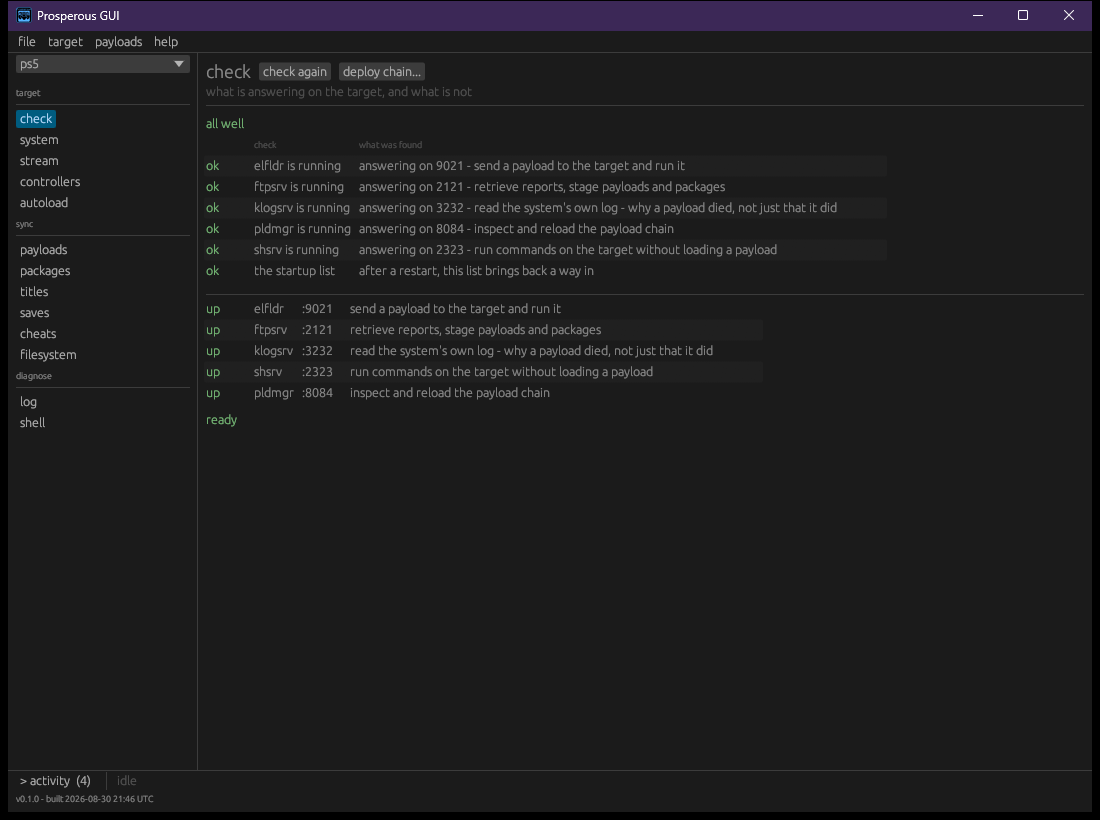
Each row is a service, and each says what it buys you rather than only whether a port is open:
elfldr |
send a payload to the target and run it |
ftpsrv |
retrieve reports, stage payloads and packages |
klogsrv |
read the system's own log - why a payload died, not just that it did |
shsrv |
run commands without loading a payload |
pldmgr |
inspect and reload the payload chain |
Reading the result
All five up. You are ready. Nothing else needs configuring.
Only the loader is down. The jailbreak has not been run, or was lost to a restart. That is normal after a power cycle and the remedy is to run it again - which is why the loader is checked first: its failure has a different fix from every other failure here.
Everything is down. The target is off, asleep, on another network, or has not been jailbroken since its last restart. Prosperous cannot tell those apart from outside and does not guess.
A slow answer is reported, not hidden. A timing in
the result - (1510ms) - means the service did not refuse,
it never replied. Refused and timed-out look identical if all you print
is "down", and they mean different things: refused is a service that is
not running, a timeout is usually a firewall or a sleeping machine.
Nothing is registered. pros list prints
nothing and exits cleanly. That is where everyone starts, not an
error.
4. What next
- The target's storage - titles, saves and packages, both directions. This is what makes a save from real hardware into something orbistoun can mount.
- Payloads - sending one, watching it, and reading the log when it dies.
- Targets - port overrides, and what a registration does and does not remember.
- Building it - only if you would rather build than download.
If you want the detail behind a check rather than the summary:
OOPS_LOG=pros_link=trace pros check --name living-roomEvery tool in the collection takes OOPS_LOG and reads it
the same way.